Bagua (Eight Trigrams) in Chinese Tradition & Xianxia
Bagua (八卦, pronounced “bah-gwah”) is the system of eight trigrams — three-line symbols made of broken (yin) and solid (yang) lines — that forms the foundational divination and cosmological framework of Chinese thought. Originating in the I Ching (易经, Book of Changes) over 3,000 years ago, Bagua maps how the differentiation of yin and yang produces the fundamental patterns of reality. In xianxia novels, Bagua appears as protective formations, sect architecture, spiritual-sense frameworks, and cultivation specialization paths.
What Does Bagua Mean?
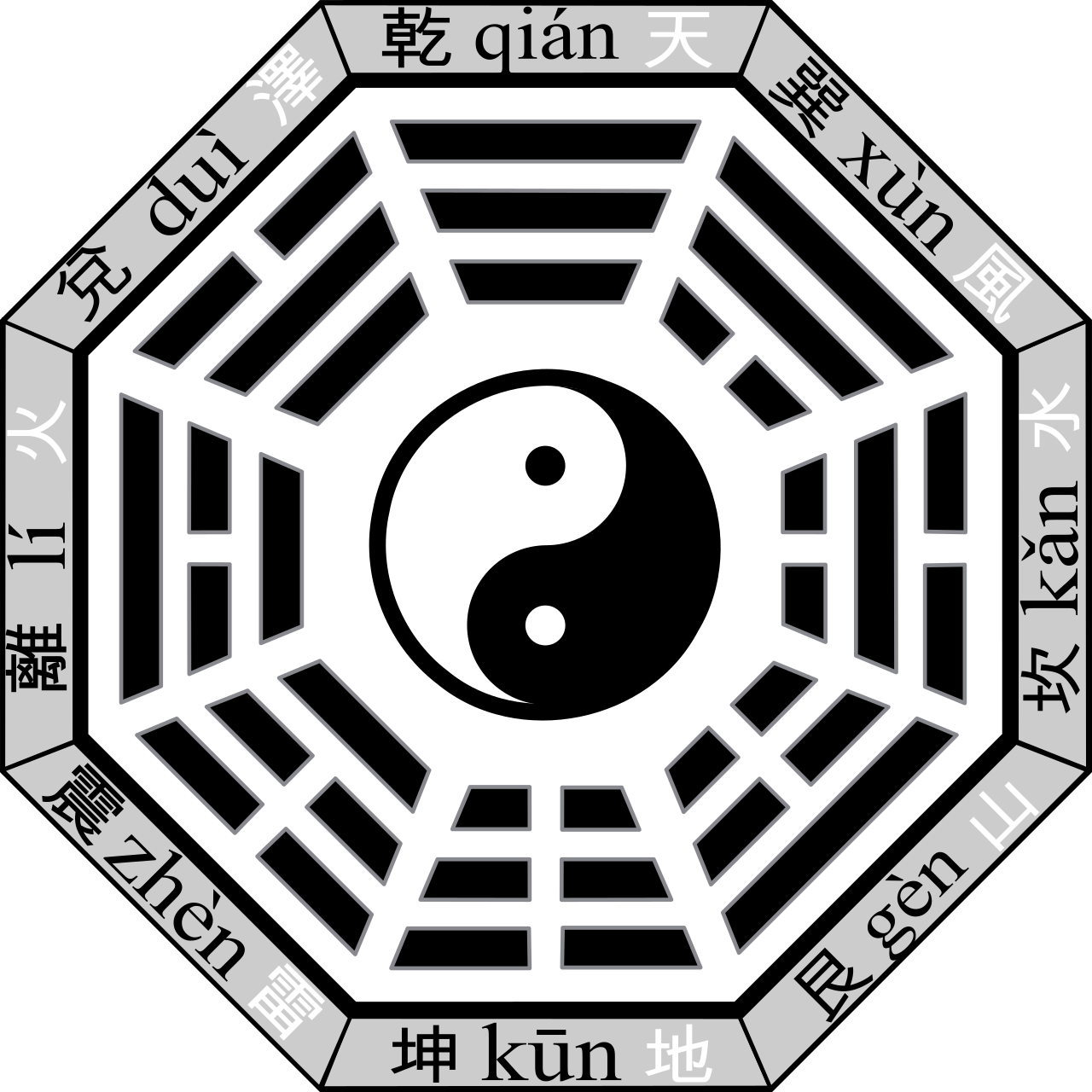
The Chinese bāguà breaks down to bā (八, “eight”) and guà (卦, “trigram, divination figure”). A trigram is a stack of three lines, each line either solid (yang, —) or broken (yin, – –). Eight possible combinations exist, and each is associated with a natural element, direction, family relationship, body part, and set of cosmological attributes.
The eight trigrams:
| Trigram | Chinese | Pinyin | Element | Direction | Lines |
|---|---|---|---|---|---|
| ☰ | 乾 | Qián | Heaven | Northwest | ⚊⚊⚊ |
| ☱ | 兑 | Duì | Lake | West | ⚊⚊⚋ |
| ☲ | 离 | Lí | Fire | South | ⚊⚋⚊ |
| ☳ | 震 | Zhèn | Thunder | East | ⚊⚋⚋ |
| ☴ | 巽 | Xùn | Wind | Southeast | ⚋⚊⚊ |
| ☵ | 坎 | Kǎn | Water | North | ⚋⚊⚋ |
| ☶ | 艮 | Gèn | Mountain | Northeast | ⚋⚋⚊ |
| ☷ | 坤 | Kūn | Earth | Southwest | ⚋⚋⚋ |
Each trigram is a specific pattern of yin-yang differentiation. Qian (all yang) and Kun (all yin) are the pure poles; the other six are intermediate states. Together, they describe the full spectrum of how yin and yang can combine in three-line units (Wikipedia: Bagua).
For the cosmological cascade that produces Bagua, see the Yin-Yang article’s cosmology section.
Pronunciation
| Pinyin | Bāguà (1st tone + 4th tone) |
| English approximation | “bah-gwah” (rhymes with “ma-pa”) |
| Simplified Chinese | 八卦 |
| Traditional Chinese | 八卦 |
| Common translations | “eight trigrams,” “eight symbols,” “pa-kua” |
Older English texts use the Wade-Giles “pa-kua.” Modern pinyin “bagua” is standard. Both refer to the same system.
Historical Origin
The I Ching (Book of Changes)
Bagua originates in the I Ching (易经), the oldest of the Chinese classics, traditionally dated to around 1000–750 BCE. The text uses 64 hexagrams (six-line figures, made by stacking two trigrams) as a divination system. Each hexagram represents a specific situation or transition, with commentary explaining its meaning and advice for the user.
The I Ching is one of the most influential books in world history. Confucius reportedly studied it deeply; the Ten Wings commentary appendices (traditionally attributed to him) explain the cosmological significance of the trigrams. The text shaped Confucianism, Daoism, and Chinese Buddhism; the binary system of broken/solid lines inspired Leibniz’s work on binary arithmetic in the 17th century (Wikipedia: I Ching).
The Two Arrangements: Fuxi and King Wen
There are two traditional arrangements of the Bagua:
-
Fuxi (Earlier Heaven / 先天八卦): The trigrams are arranged in opposite pairs (Qian ↔ Kun, Li ↔ Kan, etc.). This arrangement represents the cosmological structure of reality in balance — the ideal pattern before manifestation. Attributed to the legendary Fuxi (伏羲), a mythological culture hero.
-
King Wen (Later Heaven / 后天八卦): The trigrams are arranged in a seasonal cycle (Zhen=spring, Li=summer, Dui=autumn, Kan=winter). This arrangement represents the temporal sequence of change — how reality actually unfolds over time. Attributed to King Wen of Zhou (周文王, c. 1152–1056 BCE).
Both arrangements appear constantly in xianxia — Fuxi for static formations, King Wen for moving cycles.
How Bagua Functions in Real Chinese Culture
Bagua is not just historical. It operates across multiple living traditions:
Martial Arts: Baguazhang
Baguazhang (八卦掌, “eight trigram palm”) is one of the three main internal Chinese martial arts, alongside taijiquan and xingyiquan. Practitioners walk in circular patterns, changing direction according to bagua principles, and use palm strikes rather than fists. The art was formalized in the 19th century by Dong Haichuan but draws on much older Daoist circle-walking practices (Wikipedia: Baguazhang).
Feng Shui
The bagua map (八卦图) is a fundamental feng shui tool. A space is divided into eight sectors corresponding to the eight trigrams, each associated with a life area (career, relationships, wealth, etc.). Practitioners assess and adjust the qi of each sector to harmonize the space.
Daoist Ritual and Talismans
Bagua appears on Daoist mirrors, swords, talismans, and temple architecture. The trigrams are understood as a complete map of cosmic forces; inscribing them on an object imbues it with the full range of protective and harmonizing power. Bagua mirrors are still commonly seen on Chinese buildings today.
Traditional Chinese Medicine
Some TCM systems map the eight trigrams to body systems, diagnostic patterns, or acupuncture point groups. The I Ching is also used as a diagnostic tool in classical Chinese medicine — the physician’s intuition, refined by I Ching study, helps identify patterns in symptoms.
How Xianxia Novels Use Bagua
Bagua Formations (八卦阵)
The most common xianxia use. A bagua formation is a spatial array laid out in the eight-trigram pattern, typically used for:
- Defense: Surrounding a sect, treasure, or person with an array that channels defensive qi in eight directions
- Trapping: Enclosing enemies in a bagua they cannot escape; each direction requires a different counter
- Cultivation acceleration: A bagua array in a meditation chamber concentrates qi from eight sources
- Sealing: Binding a powerful being (demonic beast, sealed ancestor, ancient treasure) using the eight-direction structure
Breaking a bagua formation is a standard xianxia plot puzzle. The protagonist must identify which trigram is the array’s “eye” (阵眼) and disrupt it; the other seven trigrams then collapse.
Bagua Sect Architecture
Many fictional sects are built in the bagua pattern: eight peaks arranged around a central one, or eight halls surrounding a main hall. This is not aesthetic — it’s cosmological. The sect’s physical layout channels qi according to bagua principles, accelerating cultivation for members.
Bagua Sword and Movement Techniques
Combat techniques based on bagua:
- Bagua footwork: The cultivator moves in circular patterns, never directly forward, making them difficult to strike
- Bagua sword: A sword style with eight fundamental cuts, each corresponding to a trigram, that combine into a continuous flow
- Bagua palm: Direct inheritance from real baguazhang; palm strikes that channel qi in eight-directional patterns
Bagua Spiritual Sense
Some novels describe a specialized form of spiritual sense projected in a bagua pattern, allowing the cultivator to perceive eight directions simultaneously with no blind spots. This is typically a higher-realm technique.
Bagua as a Cultivation Path
A few cultivators in xianxia specialize in bagua as their dao — comprehending the eight trigrams deeply enough to use them as a personal cultivation framework. A bagua-specialist protagonist often has eight signature techniques (one per trigram) that combine into a final unified attack.
Bagua Treasures
Common bagua-themed treasures:
- Bagua mirror (八卦镜): Reflects attacks or reveals hidden enemies; sometimes a soul-attack weapon
- Bagua cauldron (八卦鼎): An alchemy cauldron with bagua inscriptions, refining pills using the eight-direction principle
- Bagua robe (八卦衣): A defensive robe woven with bagua patterns that absorbs eight types of elemental attacks
- Bagua jade (八卦玉): A jade talisman carved with bagua, used for protection or as a storage medium
The 64 Hexagrams (六十四卦)
When two trigrams are stacked, the result is a hexagram (六十四卦). There are 8 × 8 = 64 possible hexagrams, each describing a more specific situation than a single trigram. The I Ching is built around these 64 hexagrams.
In xianxia, the 64 hexagrams sometimes appear as:
- A higher-level formation system (64-cell array vs. 8-cell)
- A divination technique the protagonist uses
- A sealed script (64 hexagrams as a writing system for ancient texts)
- The conceptual structure for a 64-move ultimate technique
The 64-hexagram layer is rarer than the basic 8-trigram layer, typically reserved for high-realm or protagonist-exclusive content.
Related Terms
- Yin and Yang — the duality that produces the trigrams
- Taiji — the unified principle preceding yin-yang
- Wuji — the void preceding Taiji
- Spiritual Sense — projected awareness sometimes arranged in bagua
- Dao — the cosmic principle the trigrams express
- Sect — often built in bagua architectural patterns
Common Misconceptions
“Bagua is just a martial art.” Baguazhang is a martial art that takes its name and mechanics from the bagua cosmological system. The system is over 3,000 years old and underlies divination, medicine, feng shui, and Daoist ritual. The martial art is one specific application.
“The bagua is the same as the taijitu.” Different symbols. The taijitu is the swirling yin-yang circle. The bagua is the eight three-line trigrams, often arranged around the taijitu in a single combined diagram. The combination (bagua surrounding taijitu) is the most common Chinese cosmological image and appears on the South Korean flag (with four of the eight trigrams).
“Bagua means ‘eight elements.'” The trigrams correspond to elements (heaven, earth, water, fire, wind, thunder, mountain, lake), but the elements are attributes of the trigrams, not the trigrams themselves. The trigrams are patterns of yin and yang lines; the elements are what those patterns represent in nature.
FAQ
Q: Why do xianxia sects always have eight peaks?
Because the bagua pattern requires eight positions. Eight peaks around a central one is the spatial expression of the bagua cosmology — each peak corresponds to one trigram, and the central peak corresponds to Taiji or the dao itself. This layout channels qi through the bagua structure, benefiting all sect members’ cultivation.
Q: Can a cultivator master all eight trigrams?
In theory, yes — and some protagonists do. But most cultivators specialize in one or two trigrams that match their spiritual root and elemental affinity. A fire-root cultivator specializes in Li (fire trigram); a water-root cultivator in Kan. Mastering all eight typically requires Taiji-level comprehension — the ability to hold all eight simultaneously as facets of a unified whole.
Q: How is bagua different from the Western astrological elements?
Western astrology has four elements (fire, earth, air, water) arranged as static categories. Bagua has eight trigrams that are dynamic — each is a pattern of yin and yang in motion, and they constantly transform into each other in cycles. Bagua is closer to a phase diagram than a periodic table.
See Also
- Yin and Yang in Chinese Tradition & Xianxia — the cosmological framework
- Taiji — the supreme ultimate that produces yin-yang
- Wuji — the void preceding all differentiation
- Daoism in Xianxia — the religious tradition using bagua
- Cultivation Realms Explained — where bagua comprehension matters
Sources:
– Bagua — Wikipedia
– I Ching — Wikipedia
– Baguazhang — Wikipedia
– Trigram (I Ching) — Wikipedia
– King Wen of Zhou — Wikipedia
– Wilhelm, Richard (trans.). The I Ching or Book of Changes. Princeton University Press, 1950.